Speed Reducer
The Speed Reducer (Golinski) example is an engineering benchmark problem. It minimizes the weight of a gear-box / speed reducer subject to mechanical constraints such as gear-tooth bending and contact stresses, shaft deflection and stress limits, and geometric requirements. The gear parameters (tooth width, module, and number of pinion teeth) are shared across the subsystems, while each shaft subsystem carries its own local variables. It is taken from [32], [36], and [37].
1. Problem formulation
Following the Distributed Design Approach, the problem is formulated as a set of coupled subsystem optimization problems through shared design variables \({}^{i}_{j}\)\(z\). The distributed formulation of this example is shown below:
2. Use-case implementation
The complete set of use-case specific files is available in the API Reference
under userfiles/SpeedReducer/.
3. Coordination method
This example is configured in
InputFile.py to be solved with
the
Augmented Lagrangian Coordination (ALC)
method. Alternative coordination methods are available as commented-out options
in the same file. The exemplary chosen coordination method and its
hyperparameters read as follows:
self._coordinationmethod: CoordinationMethodInterface = ALC(convergence_indicator_innerloop=ConvergenceIndicator_Innerloop_DeWit(tolerancetotalobjective=1E-4),
                                                            convergence_indicator_outerloop=ConvergenceIndicator_Outerloop_DeWit(toleranceconsistency=1E-5),
                                                            updatecouplingparametermethod_outerloop=UpdateCouplingParameterMethod_AugLagMultipliersAdaptiveWeights(
                                                                beta=1.3,
                                                                gamma=0.5,
                                                                initialweight=0.01,
                                                                initialmultiplier=0.0),
                                                            iterationscheme=SequentialForward())
4. Processing and results
Executing the coordination method logs the optimization data into .dill
history files, which can be analyzed and visualized with the
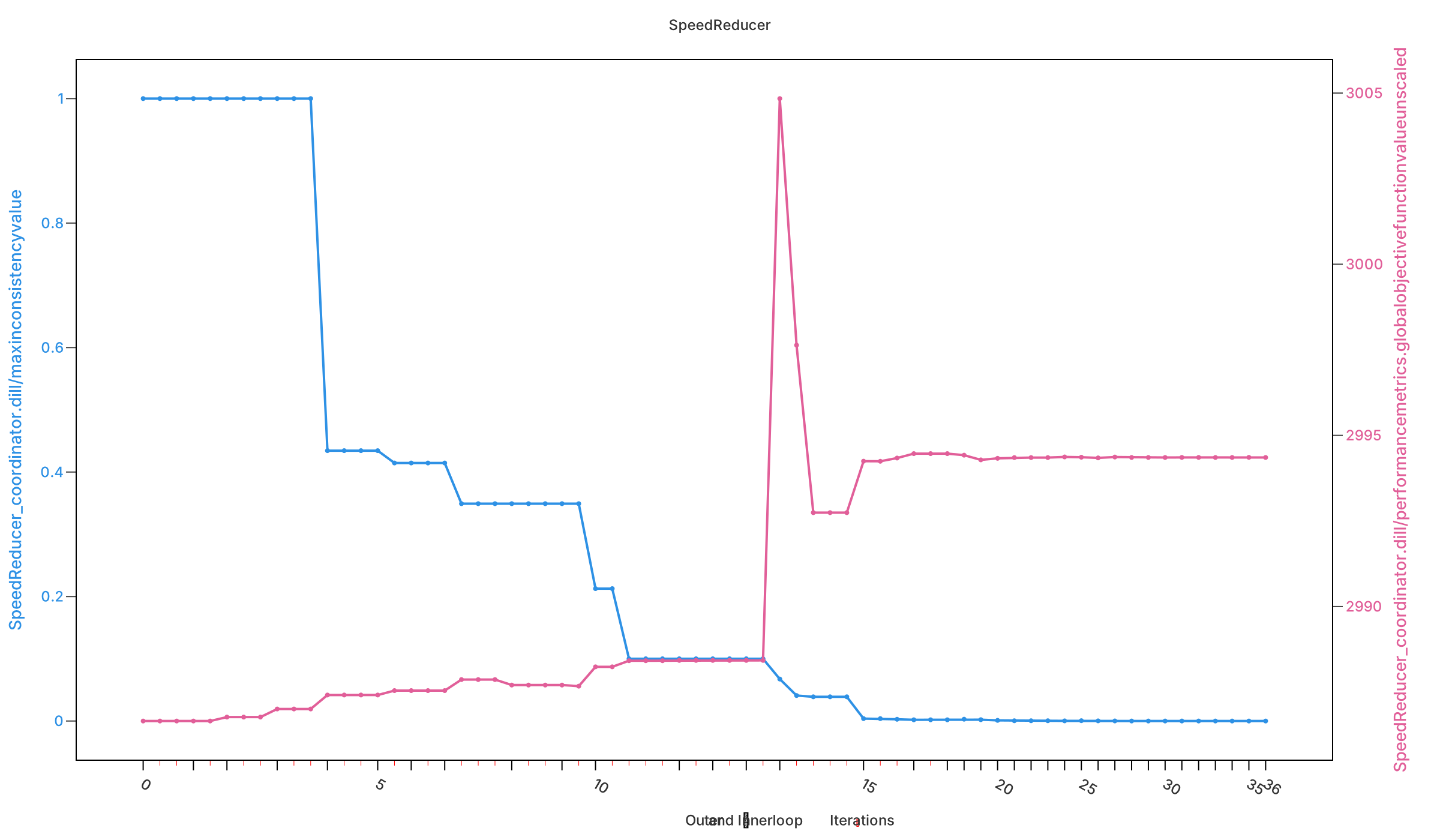
DDO Viewer GUI. The figure below
shows exemplary information of the executed distributed design optimization for
this example: